
Watch what rulers do and discount what their lawyers write. A doctrine may divide the world into the faithful and the enemy for a thousand years while the faithful sign treaties, marry their daughters to the enemy, and lend him their fleet. When practice has contradicted a rule for centuries, the rule is already dead. What remains is to bury it, so that no one can dig it up.
The Fleet at Toulon
In the autumn of 1543 the people of Toulon, on the southern coast of France, were ordered by their king to leave their homes.
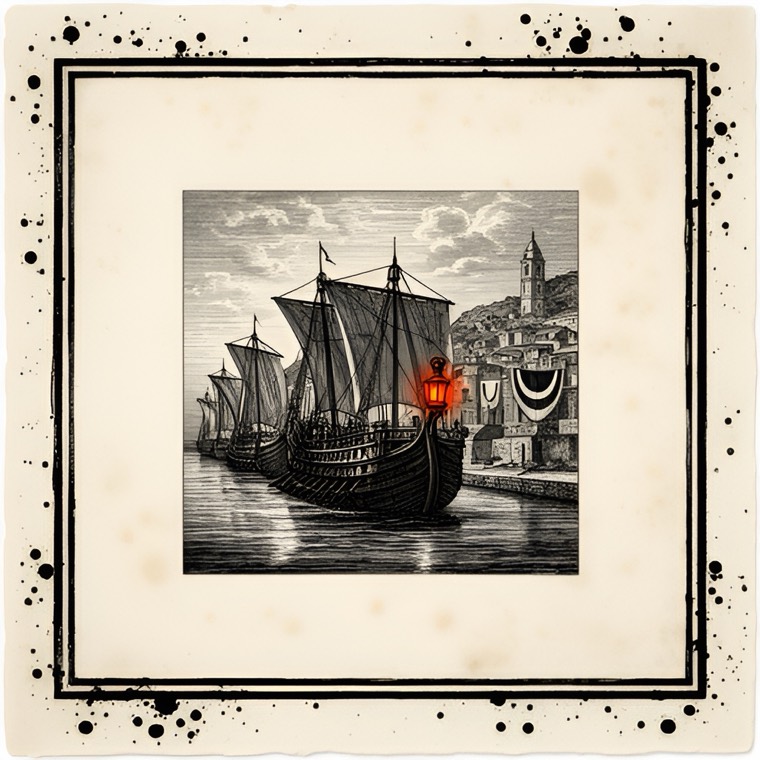
They were given a few days. Heads of households were allowed to stay, but the women and children were sent inland, and the town was emptied to make room for its guests. The guests arrived by sea: more than a hundred galleys flying the green banners of the Ottoman sultan, carrying some thirty thousand men under the most feared admiral of the age, Khayr al-Din, whom the Christians called Barbarossa.
They had not come as conquerors. The King of France had invited them. For eight months the Ottoman fleet wintered in a French harbor at French expense. The cathedral of Toulon was turned into a mosque. The call to prayer sounded five times a day over a town in the realm of the Most Christian King. A slave market did business on the quay. French observers noted, with some surprise, that the Turkish camp was better disciplined than any Christian army they had seen.
It was the scandal of Europe, and it was only the most visible moment of an arrangement that lasted, in one form or another, for two and a half centuries. Francis I of France had been fighting the Habsburg emperor Charles V for most of his reign and losing. In 1525 he had been captured in battle and carried off to Madrid. From his prison, by way of his mother, he sent a secret appeal to the one power on earth capable of breaking the emperor: Suleiman the Magnificent, Sultan of the Ottomans, Caliph of Islam, Commander of the Faithful.
Suleiman replied in the grand style, listing his titles for half a page before addressing Francis as king of the province of France. But he said yes. In 1536 the two courts concluded a formal alliance. French and Ottoman fleets campaigned together against Christian cities. French gunners served in Ottoman sieges.
So it came about that the successor of the Prophet and the heir of Saint Louis made common cause against the Holy Roman Emperor, and neither of them saw any difficulty in it.
4 more minutes: The Map with Two Colors, Interpretation, The Lesson
Members read every case to the end and watch each film before release. The complete argument is also in the book.