
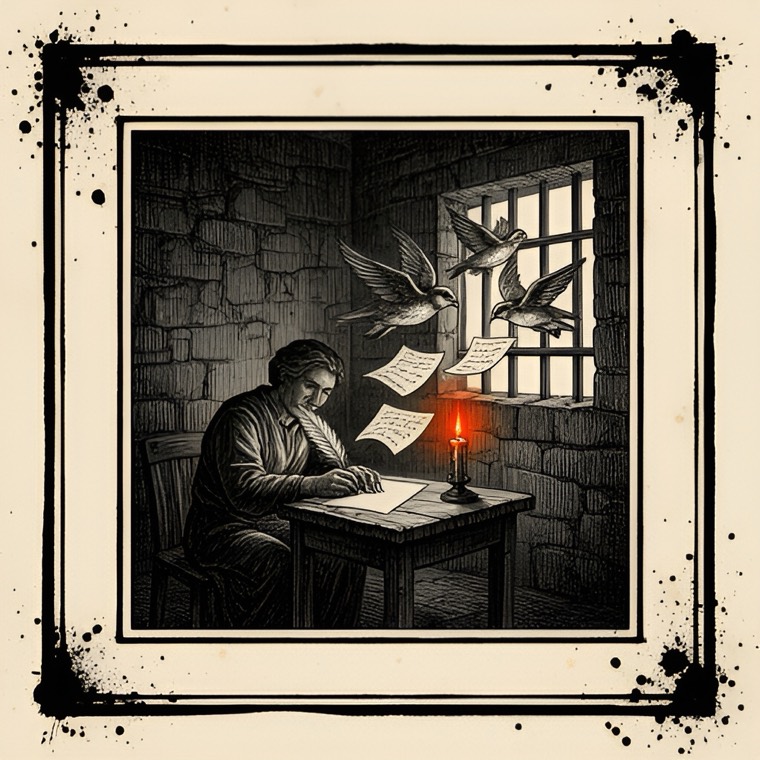
No refutation written by an enemy is worth a tenth of a confession written by a founder. When the man who built the doctrine stands up and says that he was wrong, he takes with him the authority on which every follower relied. Seek out such men and give them paper. Their repentance is the one weapon a movement cannot answer.
The Fax from Tora Prison
In May 2007 the London office of an Arabic newspaper received a fax from an inmate of Tora Prison, on the southern edge of Cairo. It announced that the sender had completed a new book, and that the book would repudiate the violence being done around the world in the name of Islam.
The sender was a surgeon in his late fifties named Sayyid Imam al-Sharif. Almost no one in the West had heard of him. Among jihadists he was a legend, known by the pen name Dr. Fadl.
In the 1970s he had been a medical student in Cairo alongside a younger man named Ayman al-Zawahiri, and the two had built the underground organization called Islamic Jihad. He was its first leader. In Peshawar in the 1980s, treating wounded fighters from the Afghan war, he wrote the two books that became the legal foundation of the global movement. One was a manual of preparation for holy war that was studied in every training camp in Afghanistan. The other, more than a thousand pages long, argued that armed struggle was the personal duty of every Muslim and that rulers who did not govern by religious law were apostates to be fought. He sat on the first council of al-Qaeda. The men who planned the attacks of September 2001 had been formed by his writings.
Now, from a cell, he took it back.
The book was serialized that November in an Egyptian and a Kuwaiti newspaper. Its argument was made entirely from Islamic law, which he knew better than any of his former comrades. The conditions for lawful war, he wrote, are almost never met by those now claiming to wage it. A Muslim who enters a foreign country on a visa has made a contract of safety with its people and is forbidden to harm them. It is forbidden to kill civilians, tourists, or people of a different sect, and to steal in order to finance the struggle. Those who had attacked America, he said, had brought ruin on Muslims and answered to no law but their own ambition. We are prohibited from committing aggression, he wrote, even if the enemies of Islam do that.
Zawahiri, by then the second man in al-Qaeda, hiding somewhere on the Afghan frontier, was alarmed enough to write a reply. It ran to some two hundred pages.
5 more minutes: The Leaders in the Dock, The Priest of Hispaniola, Interpretation, The Method
Members read every case to the end and watch each film before release. The complete argument is also in the book.