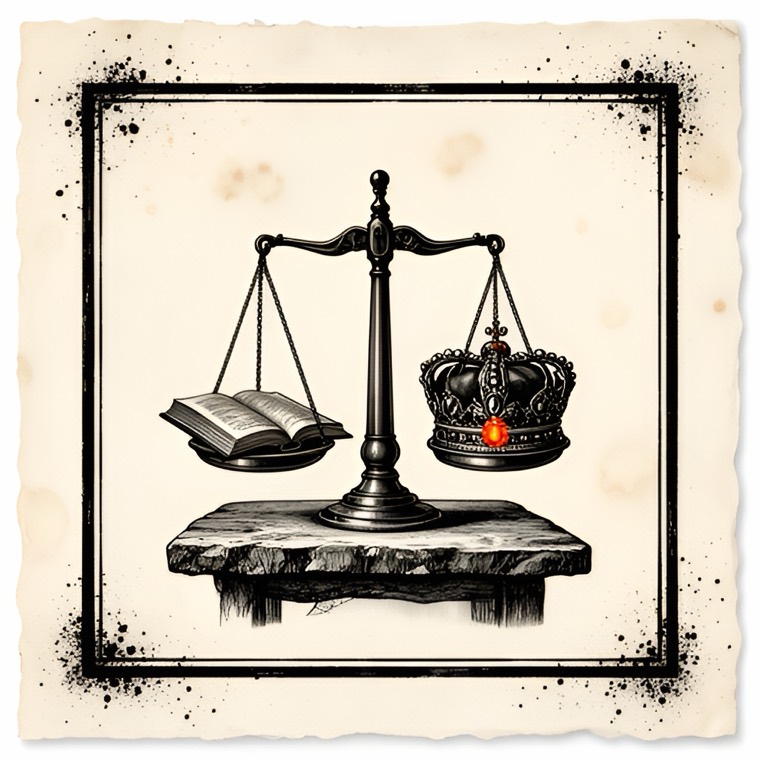
Where the power to bless and the power to punish rest in different hands, each restrains the other, and in the space between them freedom grows. Where one man holds both, nothing restrains him, and when he is gone his every act of state becomes holy precedent. The most dangerous moment in the life of any faith is the day its prophet is handed a throne.
The Emperor in the Snow
In January 1077 the most powerful ruler in Europe stood barefoot in the snow outside a castle in northern Italy, wearing the coarse wool shirt of a penitent.
He was Henry IV, king of the Germans and heir to the empire of Charlemagne. Inside the castle of Canossa, warm and unhurried, sat Pope Gregory VII, a man of humble birth. The two had quarreled over a question that sounds dry and was in fact the whole matter of who ruled Europe: which of them had the right to appoint bishops. Henry had declared the Pope deposed. The Pope had answered by excommunicating the king and releasing his subjects from their oaths. Within months the German princes were in revolt, and Henry understood that he would lose his crown unless the sentence was lifted.
So he crossed the Alps in midwinter and presented himself at the gate. For three days, the chroniclers say, he stood in the courtyard from morning until dusk, fasting and weeping, while the Pope considered. On the fourth day Gregory let him in and absolved him.
It settled nothing. Within a few years Henry was back with an army and Gregory died in exile. Popes and emperors went on fighting for two more centuries. But the image never left the memory of Europe: a king on his knees before a priest, and a priest who in the end could not hold the king.
4 more minutes: The Arbiter of Medina, Interpretation, The Lesson
Members read every case to the end and watch each film before release. The complete argument is also in the book.